
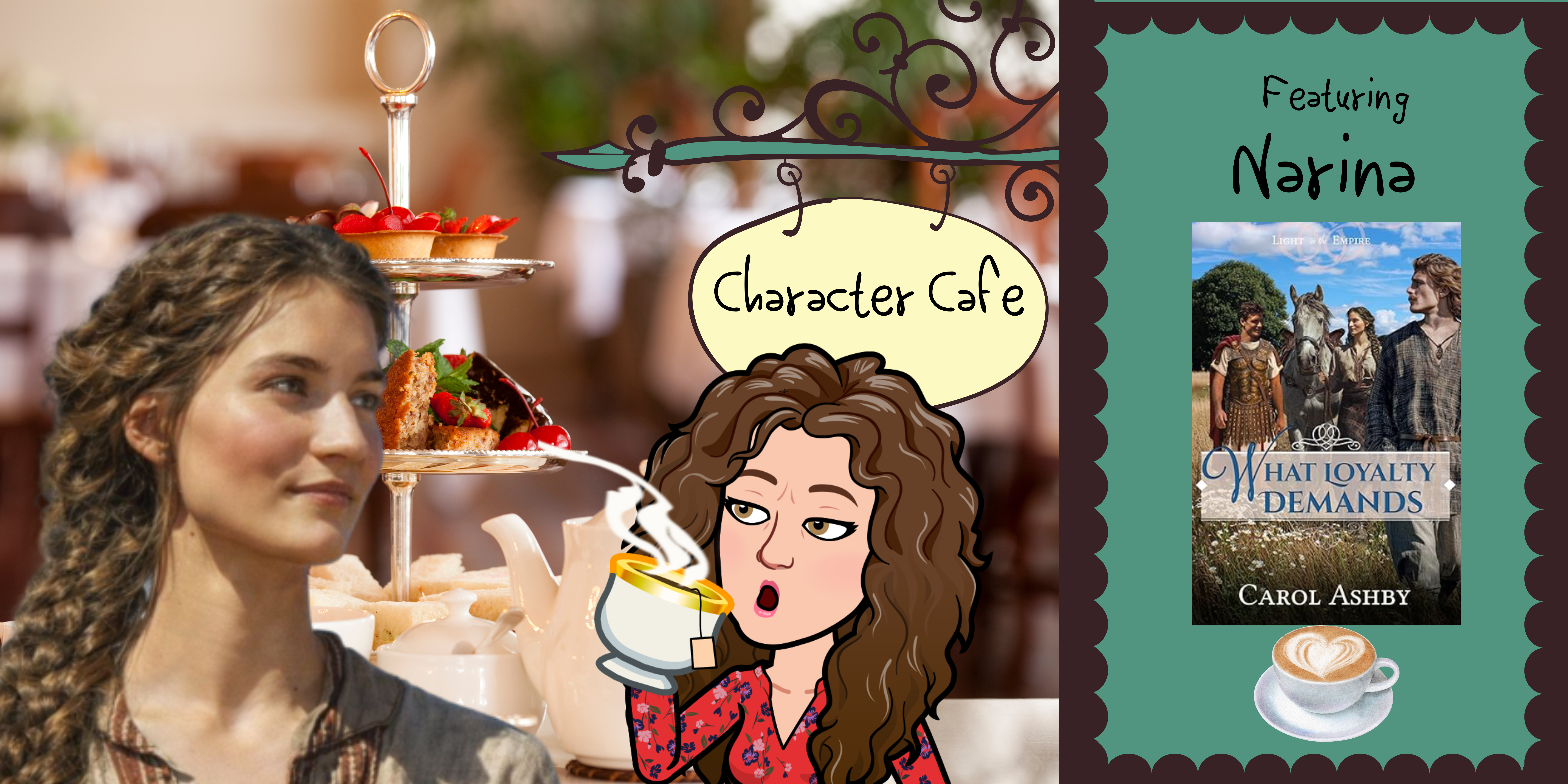
Amy: Welcome to Character Cafe, Narina. For all the folks here who are as excited as I am to meet someone from the Roman Empire, I’ll start with this question: if someone met you for the first time, how would you describe yourself?
Narina: I suppose I’d say I’m someone who belongs in more than one place, yet in none of them. My mother was Roman, my father British, so I learned early how to listen, how to translate not just words but ways of thinking. Mostly, though, I try to be someone who brings peace where I can.
Amy: When I went to London a few years ago, I marveled that there were still remnants of Roman rule 1,600plus years later. I was thrilled to touch bricks made during Roman rule when I visited the Tower of London. Narina, what were the Romans really like there in Britain?
Narina: They’re disciplined and practical, even when far from home. Romans believe the world works best when everything has an order—roads laid straight, laws written clearly, duties clearly named. That brings stability, but it can also feel rigid to people who’ve lived by tradition and clan for generations.
Amy: How does Roman rule affect your daily life?
Narina: It depends where you live. In towns like Eboracum, life feels very Roman with stone buildings, baths, markets, and soldiers everywhere. In the countryside, especially among the Brigantes, life hasn’t changed as much. People still farm, raise animals, and gather by clan. However, Roman taxes, patrols, and laws are never far away.
Amy: What is life like for ordinary people?
Narina: Most people work constantly. Farmers rise before dawn, merchants haggle until their voices are hoarse, and soldiers drill until their bodies ache. There’s laughter and feasting too. With all the drinking of mead and ale, especially on market days, well, things could get rowdy. I’ve seen many brawls. But survival always comes first.
Amy: You move between Roman and British worlds. Do they ever truly mix?
Narina: Sometimes. Trade brings people together. Shared danger does too. But trust comes slowly. Romans value citizenship and law; Britons value loyalty and their memories of their ancestors. The differences make it hard for the two groups to mesh.
Amy: As a Christian, how do you see this world?
Narina: I see people longing for safety. Rome promises order. The tribes promise belonging. God offers something deeper—hope that doesn’t depend on power or blood. In times like these, that hope can feel dangerous.
Amy: I heard that you’re the only Christian in your family. What is that like?
Narina: Lonely at times. Faith gives me hope, but it also sets me apart. My brothers and cousins love me, yet they don’t always understand why I choose mercy when anger feels easier. I pray often that they’ll see what I see—that God’s way leads to life, not just survival.
Amy: Two very important men in your life seem destined to become enemies. How does that affect you?
Narina: Heavily. One represents Rome, order, and duty. The other represents blood, loyalty, and resistance. I care for them both, and that puts me in an impossible place. I fear that if I choose wrong—or fail to choose at all—I may lose them forever.
Amy: If unrest ever turns into rebellion, where will your loyalty lie?
Narina: That’s the question that keeps me awake at night. I love my people, and I respect Roman law, but my deepest loyalty is to God. Sometimes that means standing still while the world demands I take a side. Sometimes it means speaking when silence would be safer.
Amy: What do you hope readers will understand about you?
Narina: That faith doesn’t make choices easy. However, faith makes choices meaningful. Loving others can mean risking heartbreak.
Amy: You seem to love working with the horses. What do they mean to you?
Narina: Horses are honest creatures. If they trust you, it’s because you’ve earned it. Watching a foal learn to stand or nurse reminds me that life is fragile, but also stubbornly determined. There’s comfort in caring for something that depends on you so completely.

Amy: Your father left you in charge of the farm at a young age. How did that shape you?
Narina: It forced me to grow up quickly, but it also told me he believed in me. I was only eighteen, yet he trusted my judgment more than my brothers’ when it came to the herd. Every decision I make here still feels like a way of honoring him.
Amy: You move easily between Roman and tribal worlds. Why do you think that is?
Narina: I learned young that listening matters more than insisting. Like I said before, Romans value order and contracts; my Brigantian kin value kinship and honor. I try to respect both.
Amy: You’re known as a fair horse trader. Why is that important to you?
Narina: Because God sees even the smallest deception. A lie might earn more coin today, but it costs something far greater tomorrow. I’d rather sell fewer horses honestly than profit from trickery and carry that weight on my conscience.
Amy: Your brothers chose Roman lives and Roman wives. How does that affect your relationship?
Narina: We love one another, but there’s distance. They are comfortable where rules are written and enforced, while I live among people who remember old wounds. I sometimes feel like a bridge no one wants to cross—useful, but never home.
Amy: What do you feel when you think about your family’s success?
Narina: Gratitude—and responsibility. My father earned everything we have through years of service and sacrifice. Wealth isn’t a shield; it’s a trust. What we do with it matters far more than how we gained it.
Amy: When you look toward the future, what do you hope for most?
Narina: Peace that lasts longer than a season. For my people, my family, and those I love to choose life over pride. And for the courage to stand firm when doing what’s right costs more than I think I can bear.

Amy: At the beginning of the novel, you hear that someone you did business with has died, why does it affect you so deeply?
Narina: Because he wasn’t just a customer. Atilianus was kind, and he trusted me. When you trade fairly and speak often with someone, you begin to feel responsible for them in a small way. I believe people matter more than the coins they leave behind.
Amy: Your brother seems quick to move on when opportunity presents itself. I couldn’t believe how quickly he had you setting up shop at one point.
Narina: Minconus means well, but he looks forward while I look at the cost. I think about what we might lose as much as what we might gain. Someone has to ask whether a choice is wise, not just profitable.
Amy: You pray quietly before agreeing to financial decisions. Why is that important to you?
Narina: Because I don’t trust myself to see everything clearly. Money can blind even good people. When I pray, I’m asking God to keep me from harming my family through a choice that feels urgent but isn’t right.
Amy: You’re technically under your brother’s authority. How does that sit with you?
Narina: It’s difficult. I respect Roman law and my father’s wishes, but obedience doesn’t mean silence. I’ve learned to speak carefully—firmly, but without defiance. That balance takes more strength than open rebellion.
Amy: You often protect the horses—and the people connected to them. Why?
Narina: Because both depend on us being honorable. A horse sold too young or poorly matched to a rider can suffer. A person misled by half-truths can lose more than money. God cares about how we treat what’s been entrusted to us.
Amy: When you worry about the inns and the people who pass through them, what concerns you most?
Narina: Safety. Not everyone who seeks lodging is kind, and not everyone who serves them is protected. I’ve seen what happens when profit is valued over people. I don’t want our family’s name tied to harm we could have prevented.
Amy: Readers, as you can see, I am fascinated by Narina’s life. I could keep asking her questions until way past lunch — but then I would neglect other customers here at Character Cafe.
Narina: Well, I have many chores to do as well. Though it has been lovely talking to you. [Sets a small leather-wrapped bundle into Amy’s hands] These are herbs we use for travel weariness and troubled thoughts. They won’t fix everything, but God often brings healing through simple things that grow quietly—meant to steady the heart, not just the body.

Amy: Thank you, Narina. And I have something on our Cafe menu just for you. I picked a tea and a breakfast dish that I thought would fit in with folks living in 117 AD. The dish is inspired by Rogatus’ early breakfast of still-warm bread, cheese, and hard-boiled eggs in Chapter 5. This is a Character Cafe creation :Warm Hearth Bread with Soft Cheese, Eggs, and Honeyed Herbs. We have thick slices of rustic bread, served warm and open-faced, with a spread of soft farmer’s cheese and sliced hard-boiled eggs sprinkled with a pinch of salt and crushed herbs, and a small drizzle of honey and another drizzle of olive oil over the top.
Narina: That sounds delightful. I’m eager to see what tea makes you ponder the Roman Empire…
Amy: From what I read, tea wasn’t a thing back then. Actual tea didn’t reach Britain until the late Middle Ages. But you did have herbal infusions, right?
Narina: We had hot drinks made with herbs. Sometimes we drank hot barley water or even warm drinks with vinegar or wine.
Amy: Well, because of your book, I found a new tea that I’m actually ordering for my daughter, who is having stomach troubles. I’m going to serve it with some honey. I hope you like it! Readers, here is the purchase link in case you want to find out more: https://www.heatherstummycare.com/p/teas_fennel-can-bags/fennel-tummy-teabags-can/

Narina: Thank you, Amy.
Amy: Readers, for those of you interested in history, here is the map that the author included in her book:

This map shows northern Britain during Roman times, focusing on where the Brigantes lived and who their neighbors were. It highlights important Roman roads, forts, and towns like York, Chester, and Lincoln. The rivers and coastlines help show how people and armies moved through the land.
And here’s more about What Loyalty Demands!

What Loyalty Demands: an adventure set in Roman Britain that’s filled with dangerous choices, conflicting loyalties, spiritual struggles, and a love story you’ll long remember.
When simmering unrest becomes open rebellion, do you do what’s right or what loyalty demands?
Scorned by his family since birth, Rogatus is a loner who relies on no one. He only needs two more years as a tribune, and he’ll have earned enough that the future he wants is assured, no matter what his father does to him. But as he begins his final command in Britannia, he meets the people who might end his loneliness…or his life.
With a Roman mother and British centurion father, Narina is at home in both tribal and Roman worlds. As the only Christian, she’s the peacemaker between her Roman brothers and British cousins. Cousin Sulio hates most Romans, but he loves her like a sister. When Rogatus brings his cavalrymen to their town, their chieftain wants Sulio to befriend the tribune to learn what the Romans are up to. As the tribune’s interest in Narina grows, Sulio wants to quench that before she gets hurt. But how can he do both?
When unrest becomes rebellion, old loyalties create mortal enemies. Narina has God to guide her, but her Roman friend and British cousin aren’t Christians. How can she get two strong men, who seem destined to be enemies, to choose life over death before it’s too late?
What Loyalty Demands is another exciting addition to the stand-alone Light in the Empire series of Early Church Biblical fiction novels. The story is the first set in Roman Britain, and it includes historical notes related to the events of the story.
“This is a fabulous ancient-world series of novels that follow the lives of fictional early Christians. Carol is meticulous with her research and a true expert on Ancient Rome! History lovers and those who enjoy my biblical books are going to LOVE this series!” — Roseanna White, best-selling author and Christy Award winner.
If you enjoy the Roman-era Biblical fiction of Tessa Afshar and Francine River’s Mark of the Lion series, you’ll love the stand-alone novels of the Light in the Empire series.

Leave a Reply