
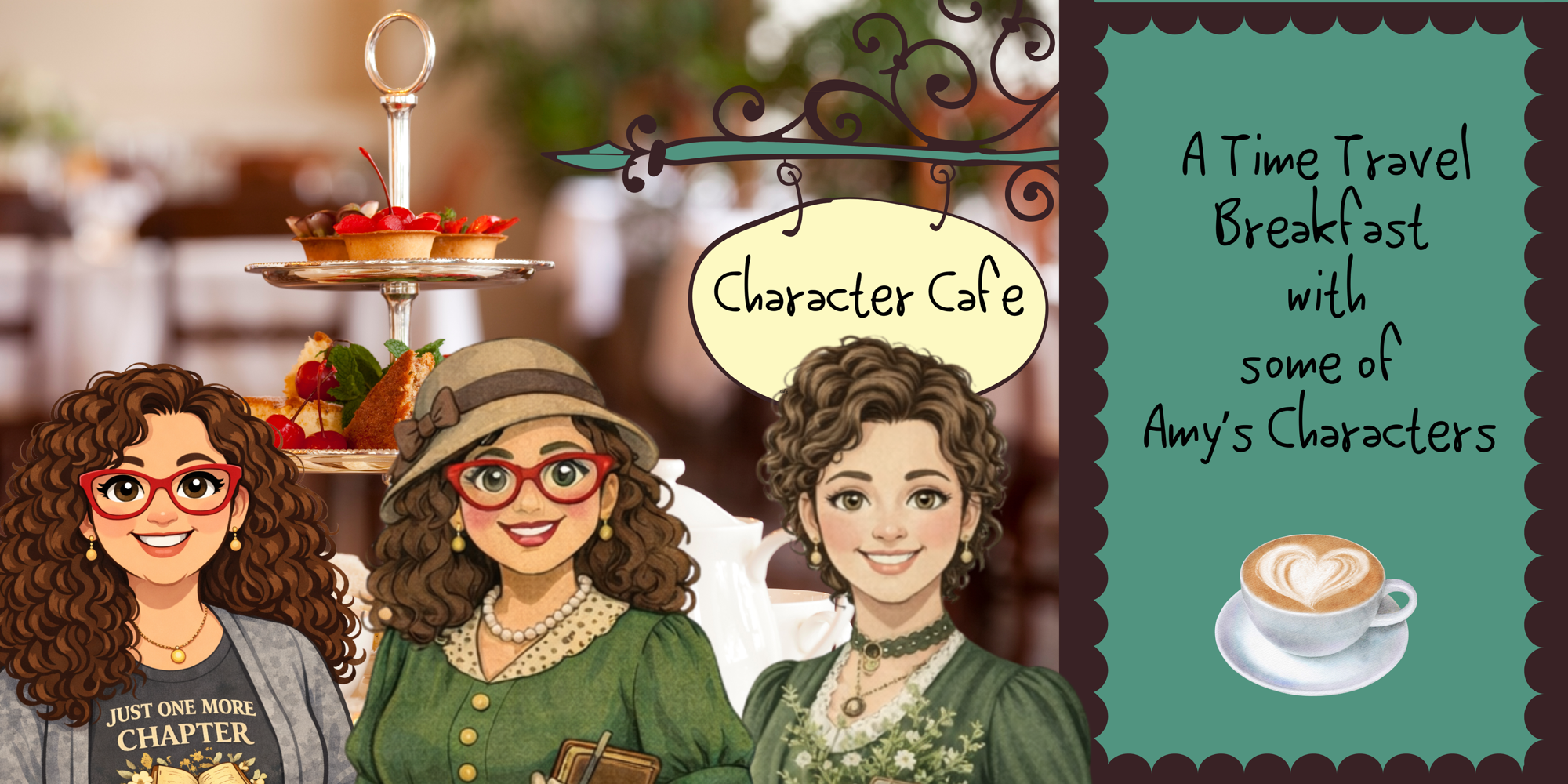
A Special Morning at Character Cafe
Amy: Good morning, Character Café friends! What a treat today is. I’m sharing breakfast with leading ladies from nearly all my published novels. As many of you know, I tend to linger in three favorite eras: the 1880s, the 1930s, and the present day. Each group of characters is seated at its own table because we mustn’t mix corsets with cardigans too abruptly. [laughs] My fantasy and science-fiction darlings have their own corner as well: the dollhouse resident and Auryn, who lives two hundred years in the future. Do be gentle with poor Auntie Amita. Please — no cookies on her tiny foot.

My characters requested permission to read their introductions so they wouldn’t lose their nerve. Afterward, I’ll ask a few questions. Let’s begin.
Emiliana: Good morning. My name is Emiliana Kowalski. I was raised in Poland, though I was carefully tutored in English and taught to speak it properly, even when my heart still thinks in Polish. In the 1930s, I crossed the Atlantic with four young children in my care, determined to reunite with my family in America and begin a brighter chapter. During the voyage, I came to admire Austin, Viscount of Marshallford, who showed uncommon kindness to my charges as he journeyed to secure his family’s estate through marriage to an American heiress. Neither of us expected affection to complicate such practical plans. Yet once in Pennsylvania, tragedy and divided loyalties made everything uncertain. If we should ever meet again, I must ask myself whether I can trust a gentleman whose alliances threaten the very people I love — even if he once looked at a penniless Polish nanny as though she were worth far more than her circumstances.
Adelaide: Good day. I am Miss Adelaide Breck, dispenser of tonics and tinctures, and until recently, steward of my family’s good name. While Father and my brother fought in the late war between the states, I kept the apothecary standing. I have set bones, soothed fevers, balanced ledgers, and, though sorely tempted, refrained from dosing troublesome relations. Now fate has prescribed a most unexpected remedy: a practical marriage in Minnesota, romance expressly excluded. Still, I have learned that Providence has a habit of slipping unforeseen ingredients into the mixture… and sometimes the cure bears little resemblance to what one intended.

Georgina: How do you do? I am Lady Georgina Huxington, formerly the toast of three London Seasons and the despair of its bachelors. I declined so many proposals that wagers were placed upon my refusals. In a fit of sisterly duty, and perhaps reckless confidence, I vowed to accept the next suitable offer Papa approved. Thus, I married Lord Malcolm Birmingham, a reserved country gentleman who prefers tenants to titled chatter and whose quiet goodness has rather undone me. Society lost its wagers; I nearly lost my husband’s regard. Now I find myself in the most astonishing position imaginable. I am deeply in love with the very man I once intended merely to tolerate, and determined to prove myself worthy of him at last.
Amy: Wow, what angsty stories you have to tell. Let’s try to dial down the tension. Adelaide, suppose you were allowed to brew one tonic for your own life. What would you mix into it?
Adelaide: Prudence, certainly– I have relied upon it for years. A dram of courage, for good measure. And perhaps — though I would not admit it in the shop — a dash of reckless hope. The sort that dares to believe matrimony may be more than a contract carefully negotiated.
Amy: Lady Georgina, one must ask — if you could revisit your first week of marriage, what would you do differently?
Georgina: Speak less. Listen more. And for heaven’s sake, leave my pride on the dressing table. I had always imagined cleverness to be my greatest asset. It turns out humility is far more becoming — and considerably more useful in winning a husband’s heart.
Amy [smiling across the table]: Emiliana, may I ask you something a little bold? If you could return to that moment on the ship — wind in your hair, ocean stretching behind you — would you still choose the same path, knowing how complicated it would become?
Emiliana [folding her hands gently]: Yes… though perhaps I would pray more and worry less. On that deck, I believed America would be simple, with brighter streets and safer days. I did not yet understand that hope can be as tangled as love. But if I had not crossed that ocean, I would never have learned how strong my heart could be — nor how costly trust can feel. Some journeys are not meant to be easy, Miss Amy. They are meant to make us brave.
Amy: Ladies of the 1880s table, we must settle a matter of utmost importance before the scones and other treats disappear. If Character Café were to serve one tea and one dessert to represent your decade properly, what should they be?
Miss Breck, you may begin — since you’re accustomed to measuring ingredients.
Adelaide: Then I shall answer with care. The 1880s prized industry and stamina. It was not an era for weak constitutions. I suggest a strong Assam — dependable, bracing, and suited to long afternoons of both commerce and courtship. As for dessert, something respectable yet hopeful… perhaps a lemon sponge. Bright, but not frivolous.
Georgina: Lemon sponge is perfectly acceptable — provided it is properly layered and not over-sweet. The 1880s were refined, after all. We must not present ourselves as though we’ve been raised in a pantry. Assam will do, though I would insist it be served in proper china.

Emiliana: In Poland, we would serve honey cake for important occasions. It keeps well. It survives long journeys. That feels… fitting for the 1880s also. Many were crossing oceans then. Starting again.
Adelaide: Honey cake does speak of endurance.
Georgina: I suppose it may be made elegant, if done properly.
Amy: Ladies, I sense compromise brewing along with the tea.
Adelaide: Very well. Assam tea.
Emiliana: And honey cake — sweet, but strong.
Georgina: Sliced neatly. With dignity.
Amy: Done. Assam tea and honey cake — sturdy enough for pioneers, refined enough for London, and hopeful enough for anyone beginning again. I’ll have it arranged immediately… before someone suggests hardtack for authenticity.
Amy: For those of you who love the Victorian age, I am working on the sequel to A Misplaced Beauty! I know… I know… I’ve been telling you that for years. But this summer, I plan to finally put it up for presale! Now, let’s move to the 1930s table. Hello, lovely characters. Your turn to introduce yourselves!

Bridget: Hello there. I’m Bridget O’Malley. The doctors say I’ve tuberculosis, but since I’m “ambulatory,” I’m considered useful — which suits me fine. I help in the little schoolroom up on West Mountain, sharpening pencils, correcting sums, and keeping the younger ones safe. The air is sharp, the porridge is plain, we have to drink far too much milk — and the nurses swear fresh mountain breezes can cure nearly anything. I write in my diary most evenings — nothing extraordinary, just the quiet happenings of sanitarium life. Though I will say… when the fog rolls over the cure cottages, it sometimes feels as though the mountain is keeping secrets of its own.
Nellie: Well now, since everyone else is being respectable, I suppose it’s my turn to behave. I’m Nellie O’Dwyer — though if you hear “Fenella Aileen!” shouted clear across a mountain, that would be my mam reminding me of my full baptismal identity. We live just outside Scranton, and in 1931, there’s not much to spare but prayers and potatoes. When my Dadaí had to leave the mines and take a bed at West Mountain Sanitarium, I did what any sensible, responsible daughter would do — I accepted a cooking position at Clarinda House under entirely mistaken circumstances. Mind you, I can burn water if properly motivated. But I do possess determination, a flair for dramatics, and Mrs. Canfield’s Cookery Book — which I consider both culinary instructor and personal guardian angel. I’ve always dreamed of the stage, of course. Acting comes naturally to those who have practiced avoiding blame since childhood. The trouble is, the more I come to admire my employer, Mr. Mason Peale, the more I fear the truth will tumble out like an overmixed pudding. And if it does… well, I may lose more than my apron.

Amy: Bridget, what advice would you give to us, real-life characters living in modern times?
Bridget: Oh, that’s easy enough. Fresh air — and less hurry. Up on West Mountain, we’re forced to move slowly. You notice the light through the pines. You listen when someone’s breathing changes. I think half the world’s ailments come from racing about and never sitting still long enough to hear its own heart. A bit of mountain quiet would do wonders.
Amy: What about you, Nellie?
Nellie: Advice? From me? Well, that’s brave of you to ask. First, if you’re going to leap headfirst into a situation you’re not qualified for, at least bring a good cookbook and a better sense of humor. Second, don’t wait until you’re perfect to begin. If I’d waited until I could actually cook before taking a kitchen job, we’d all have starved politely. And lastly, don’t pretend so long that you forget who you truly are. Acting is grand fun on a stage, but in real life, the truth has a way of stepping into the spotlight whether you’ve rehearsed or not. So be brave enough to admit your blunders, trust that the Lord can redeem even a scorched biscuit, and never underestimate what a determined heart, and a bit of blarney, can accomplish.
Amy: Nellie and Bridget, what tea and dessert best represent your decade?
Nellie: Well, it can’t be anything too fancy. If it requires three imported ingredients and a crystal serving tray, we’re out already. I vote for plain black tea. It’s strong enough to wake a coal miner and cheap enough not to cause a family meeting.
Bridget: Strong tea makes sense. At the sanitarium, they serve it weak as rainwater, but I always wished it had more backbone. The thirties weren’t delicate years. People needed warmth they could feel clear to their fingertips.
Nellie: Exactly! No dainty sips. Something that says, “We’ll manage.”
Amy: And dessert?
Bridget: Something simple. Oatmeal cookies, perhaps. They’re filling. Sensible. No waste.

Nellie: Oatmeal cookies? Bridget, we are not hosting a church basement on a Tuesday. Though… they do stretch a pantry nicely. And you can pretend the raisins are extravagant.
Bridget (smiling softly): In hard years, extravagance is measured differently.
Nellie: True enough. All right — oatmeal cookies.
Amy: So it’s decided — strong black tea and oatmeal cookies. Practical, steady, and sweet enough to remind everyone that even in lean years, there’s still room for a little comfort.
Nellie: And if the cookies burn, we’ll call them “caramelized” and carry on.
Amy: All right, my 1930s table — lean in. I have news. The Apron Strings Tea Tales series is keeping me very busy, and I’ve been assigned two more fairy-tale retellings… both set in the 1930s.
Nellie [gasps dramatically]: Fairy tales? In the Depression? Oh, I adore it already. Nothing says “hard times” like adding a little enchantment. All right, give us a hint. Is there singing? A curse? A suspiciously large talking mole?
Amy: No talking animals or furniture. These are nonmagical, historical fiction. But one story involves a very small heroine… and the other involves a rather misunderstood gentleman.
Bridget [tilting her head thoughtfully]: A very small heroine… You wouldn’t mean Thumbelina, would you? She could fit nicely into a teacup — and I’ve seen girls on West Mountain feel just as small in a world far too large.
Nellie: Oh! And a misunderstood gentleman in the 1930s? That has to be Beauty and the Beast. Except perhaps he’s not a beast — just a brooding sort who owns too much property and not enough joy.
Amy [laughing]: You two are entirely too clever. Yes — Thumbelina and Beauty and the Beast.
Bridget: Thumbelina in the 1930s… She would have to be strong to survive that decade. How are you going to make that realistic?
Amy: It’s a surprise – but I will tell you that it is inspired by my husband’s Great-Aunt Dolly – who was very tiny even as an adult.
Nellie: And Beauty? In the thirties she’d need more than a library — she’d need grit. And maybe a good cookery book.
Amy: Naturally.
Nellie: Then I approve. Even in lean years, people still need stories where something small becomes mighty… and something hardened learns how to love.
Amy: Exactly. A spoonful of history, a dash of hardship, and just enough fairy tale to remind us that redemption never goes out of style.
And now for our modern times table! Yay!

McKay: Hi! I’m McKay Moonlight — yes, that’s my real name, and yes, I do play the fiddle, so apparently destiny had a sense of humor. I’m a college music major who nearly fainted with joy when I won a summer apprenticeship with the legendary Scottish fiddler Huntley Milne — my absolute hero, guardian of the Highlands’ sound, and living proof that genius can wear tweed. I was prepared for misty glens and ancestral inspiration, not a last-minute switch to a tiny English village along the River Deben… and certainly not for making the worst first impression of my musical career. Turns out, Maestro Milne wasn’t exactly thrilled to host a gaggle of college students while juggling family issues, emergency guardianship, and what I suspect is a purposely “misplaced” stave book. Still, I believe every great piece has dissonance before the resolution — and if I can survive awkward rehearsals, mansion treasure hunts, and a mentor who scowls in 4/4 time, I just might find the harmony I’ve been chasing all along.
Natalie: Hello — I’m Natalie. I used to believe my life was built on solid ground: loving parents, a steady future, the quiet assurance that happy endings were simply what faithful families received. Then an ancestry kit rearranged my entire history. Not long after losing my father, I discovered I had a half-sister — Alexandra — brilliant, artistic, and carrying wounds I never saw coming. Now I find myself traveling across Scotland on the Lochs & Legends Tour, trying to build a bridge between us while castles loom, bagpipes wail, and tension hums louder than the wind off the cliffs. My longtime friend Jonas has appeared out of nowhere, worried about the strange “accidents” that keep finding me, and emotions I’ve carefully buried are rising to the surface. Somewhere between ballads of jealous sisters and breathtaking Highland views, I’m learning that truth can unsettle you, forgiveness can cost you, and faith may be the only steady thing when the ground shifts beneath your feet.
Mari: Hi! I’m Mari Wilson, and I promise I never meant to cause that much trouble. All I intended to do was return a lost amber locket. Instead, I somehow wandered into the private family wing of a very whimsical lodge, demolished a little boy’s carefully engineered plastic brick masterpiece, and — in a moment I still can’t properly explain — fell asleep in his empty bed. Which is how I met Orson Barrett… and his thundercloud of protective fatherly fury. What began as a simple errand turned into a trail of secrets, stubborn pride, and a family history that refuses to stay buried. Somewhere between awkward apologies and unraveling clues, I discovered that second chances don’t always come neatly wrapped — sometimes they’re hidden inside an amber locket you were never meant to keep.

Elsie: I’m Elsie Whitmore — elementary school teacher from Oak Hills, Pennsylvania, accidental YouTube personality, and apparently… potential movie star. One minute I was grading papers and filming classroom projects for my students, and the next, one of my videos went viral and caught the attention of Graham Thurston — yes, that Graham Thurston. Now he wants me to star in a film he’s directing at Proscenium Studios in the Brooklyn Navy Yard. Acting was my childhood dream, but teaching is the work that fills my heart. Somewhere between camera tests, long calls home, and trying not to trip over my own nerves in front of a very charming leading man, I’m discovering that chasing a dream can be thrilling — and lonely. The question is, will I return to the chalkboard and the close-knit community I love, or step fully into the spotlight and see where it leads?
https://www.amazon.com/Elsie-Whitmore-Star-Oak-Hills-ebook/dp/B08Z35ZTW5/
Mari: All right, I’ll start. Elsie… be honest. When a famous actor asks you to star in his film, do you faint first or write your lesson plans?
Elsie [laughing]:Lesson plans. Always lesson plans. Someone has to make sure fractions still get taught while I’m hyperventilating in a Brooklyn studio. But Mari, you broke into a private lodge wing and fell asleep in a child’s bed. That’s far braver than an audition.
Mari: That was not bravery. That was exhaustion and poor navigation.
McKay: At least you weren’t trying to impress a musical genius who thinks smiling is optional. Elsie, how do you handle performing in front of cameras? I can barely breathe when Maestro Milne raises one eyebrow.
Elsie: I imagine my students are watching. They’re far more honest than critics.
Natalie: That’s lovely… and slightly terrifying. McKay, is it harder to impress a maestro or to survive a mansion treasure hunt?
McKay: The maestro. Treasure hunts at least offer clues. Stoic mentors just offer silence.
Mari: Natalie, your turn. Castles, secret sisters, suspicious accidents… did you ever wish you’d stayed home?
Natalie [softly]: More than once. But sometimes staying home keeps truth buried. And that’s worse.
Elsie: You’re all so brave. I’m just deciding between chalk dust and camera lights.
McKay: And I’m deciding whether my hero is also my greatest frustration.
Mari: And I’m deciding whether love always arrives wrapped in inconvenience and angst.
Natalie: I’m afraid It usually does. Especially the early stages.
Amy [clapping her hands]: Ladies! Before this turns into a therapy circle, we have pressing business. We must choose the tea and dessert to represent modern times at Character Café.
Mari: Something cozy. Maybe chai? It feels like autumn and second chances.
McKay: Chai is lovely, but modern times deserve something global. Maybe a lavender earl grey? Sophisticated, but still comforting.
Elsie: Lavender feels a bit dramatic. What about a classic English breakfast? Reliable. Homey.
Natalie: Modern life is layered — bittersweet and bright at the same time. Perhaps a citrus green tea? Fresh, hopeful.
Amy: Perhaps since you can’t decide, we’ll discuss dessert.
Mari: Chocolate. Obviously.
McKay: Dark chocolate torte. Intense. Musical. Broody.
Elsie: Cupcakes. Approachable. Frosted. Joyful.

Natalie: Something elegant but not fussy. Lemon raspberry tart — sweet with a little sharpness.
Mari: Oh, that’s good. It tastes like a fresh start and a little honesty.
McKay: And chai would pair beautifully with lemon raspberry.
Elsie: So would English breakfast…
Natalie: Chai feels more “now.” A blend of spices, cultures, stories.
Amy: I hear agreement brewing.
Mari: Fine. Chai tea.
McKay: And lemon raspberry tart.
Elsie: With real whipped cream.
Amy: Settled. Chai tea and lemon raspberry tart — layered, warm, and just sharp enough to keep things interesting. Modern times, represented perfectly.
Now someone pass the plates before a time traveler steals the last slice.
Oh — everyone, hold your teacups. We have a late arrival, and she has come a very long way.
Aubrey just stepped in from Wyoming — probably still carrying mountain air and a touch of dust from the open road. She works in graphic arts, steady and talented, and she’s built a life surrounded by community, counseling, and courage after surviving something no one should have to endure. She thought she had found her footing again.
What she didn’t expect was to meet Shane Phillips — a man tied to her story in the most painful way imaginable. His brother harmed her family. For years, Shane tried quietly to make restitution, sending checks that were returned, settling for prayer when nothing else seemed possible. Now they work for the same company, and their Wyoming branches are about to meet face-to-face at a conference.
Aubrey is discovering that healing is not always a straight road. Sometimes old fears stir when the past walks back into the room. And yet… sometimes redemption does too.
Aubrey, we’re honored you made it to Character Café. Why don’t you pull up a chair?

Amy: Phew — we modern folks can get carried away at times. That table reminded me of what my lunch at school sounds like with all my teacher friends! Let’s head to our fantasy and science fiction table!
Auryn: Hello. My name is Auryn Vale, born in orbit on Orbitalia, the colony that circles Earth. I’ve lived for years in the defunct garden wing — long enough to know I’ll never be voted into the Return. The Great Selection may claim to reward talent, but talent costs credits: private training modules, prime lodging, access to the Streamers — the cameras that beam Orbitalia life down to Earth. I have none of those. I’m an orphan with soil under my fingernails, coaxing stubborn plants to grow beneath faulty light panels alongside a band of equally unelectable misfits. We aren’t polished. And we certainly aren’t trending. But as the final hours of the Selection approach and Earth turns silently below us, I’ve begun to suspect that being unseen might be its own kind of freedom — and that perhaps the future was never meant to belong only to those on camera.
Amy [raising her brows]: Auryn… remind me never to complain about spotty Wi-Fi again. I love this about you — no spotlight, no sponsors, no Streamers — and yet you’re growing things the cameras can’t even measure. The garden wing may not trend, but I have a feeling it’s where the real future is taking root.
And now I will introduce our last visitor at Character Cafe. Listen carefully, readers. Auntie Amita has a tiny voice.
Auntie: Hello, dears. I am Auntie Amita of Mahogany Manor — though at present, “manor” is an ambitious term. We awoke upon an enormous table in a world far too large for comfort, our grand little mansion stranded across the cavernous floor. The sorcerer who fashioned us is gone, magic is forbidden, and nothing here is quite real — the fruit does not nourish, the fireplaces do not warm, and the sky is only painted tin. In a dollhouse, one is meant to pose prettily and wait for tea. In the big world, one must learn to survive. We are small, very small, and if the humans discover us, we shall not last long. But families, even miniature ones, are stronger than they appear. And if we are to uncover why we were made and why we were left behind, we must do so together… quietly, cleverly, and preferably without anyone stepping on us or locking us in a trunk.
Amy: And truly, Auntie Amita and Auryn would have the hardest time choosing anything at all if I were to ask them to pick a tea and a dessert to represent their stories. For Auntie Amita, nothing in her world is real — the fruit is painted, the tea is forever frozen mid-pour, and the cakes are carved from resin. She has lived surrounded by beautiful illusions, never able to taste a single crumb. And Auryn? On Orbitalia, gravity is lower than Earth’s. Tea doesn’t pour properly, crumbs don’t fall, and whipped cream would float away if you weren’t careful. Baking has to be engineered so it behaves in reduced gravity, not crumbles like a cheerful Earthly sponge. One lives in a dollhouse where food is pretend. The other in a space colony where food must cooperate with physics. So perhaps the real treat for both of them wouldn’t be a particular tea at all –it would be something simple, steady, and entirely real.
Amy: Well, dear friends, what a morning it has been.
We’ve sipped tea with apothecaries and actresses, teachers and treasure hunters, sisters, nannies, and even a future rebel in orbit. We’ve debated sponge cake versus honey cake, oatmeal cookies versus tart, and discovered that every decade — whether 1880 or 2130 — is simply full of women trying to be brave in the circumstances they’ve been given.
Some are fighting pride. Some are fighting poverty. Some are fighting gravity.
But all of them are learning the same quiet lesson: strength often grows in overlooked places — kitchens, classrooms, mountain sanitariums, dollhouse parlors, garden wings in space.
Thank you for pulling up a chair at Character Café today. Whether your world feels as small as a teacup or as vast as Earth from orbit, I hope you leave reminded that your story matters… and that there is always room at the table for one more brave beginning.
Romans 5:3–5 (ESV)
Not only that, but we rejoice in our sufferings, knowing that suffering produces endurance,
and endurance produces character, and character produces hope,
and hope does not put us to shame, because God’s love has been poured into our hearts through the Holy Spirit

Leave a Reply